
Infrastructure
Construction
Eliminate diesel fumes in urban centers and power high-torque heavy excavators 24/7 without refueling stops.
The Kinetic Blueprint
If there is power nearby, why do you need batteries? Making heavy electric machinery run on electricity 24/7.
Current industrial electrification faces a critical paradox: Heavy machinery requires immense power, yet massive batteries introduce "Charge Anxiety" and crippling weight.
Relying on static charging stations leads to 30% downtime for industrial fleets, stalling productivity and inflating operational overhead.
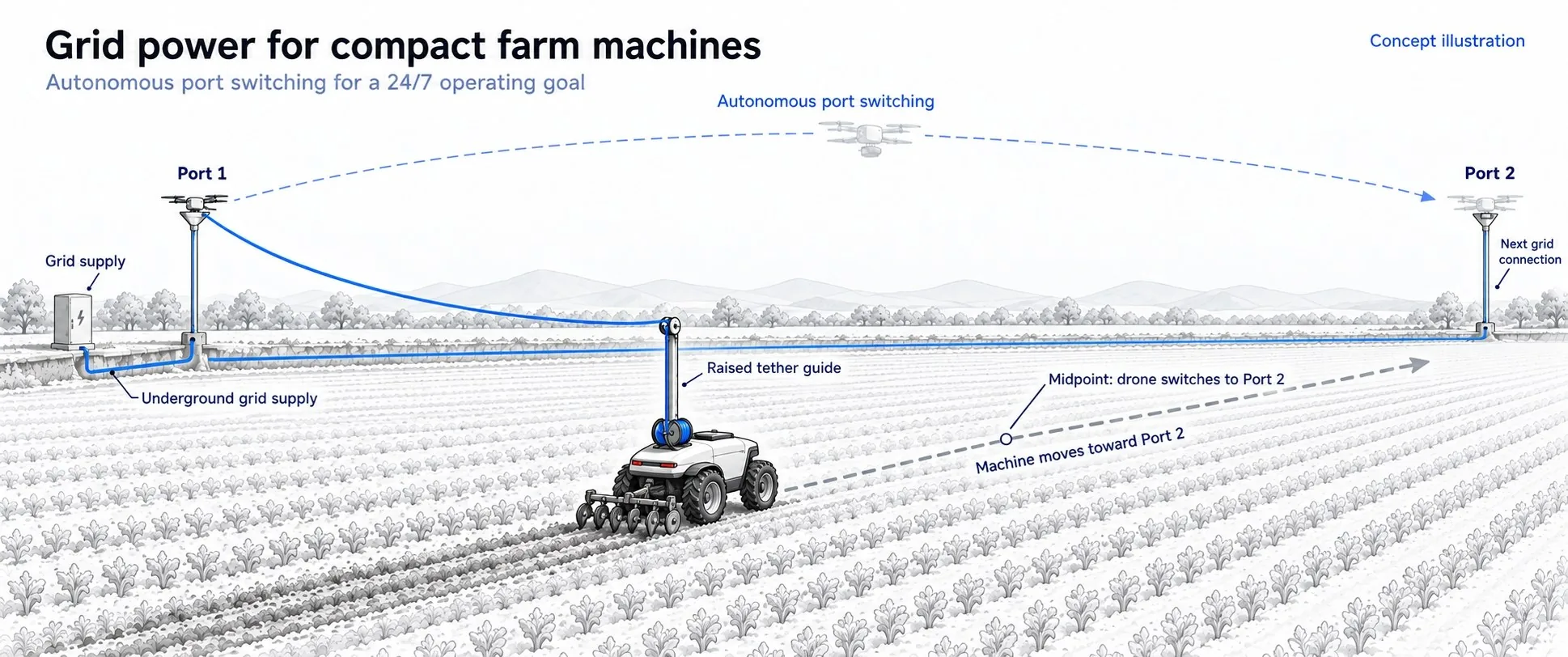
The drone transports the electrical connector to an elevated grid-connected docking port and powers down after docking.
Precision flight control transports and docks the electrical connector at the elevated grid-connected port.
Optimized power cables deliver grid-level voltage directly to the machine's motor, bypassing the need for storage.
Compatible with existing electric excavator and tractor architectures, making the transition to FPCA effortless.
How it works in the field
Power comes from an underground grid supply to elevated docking ports. The drone carries the connector to the nearest port.
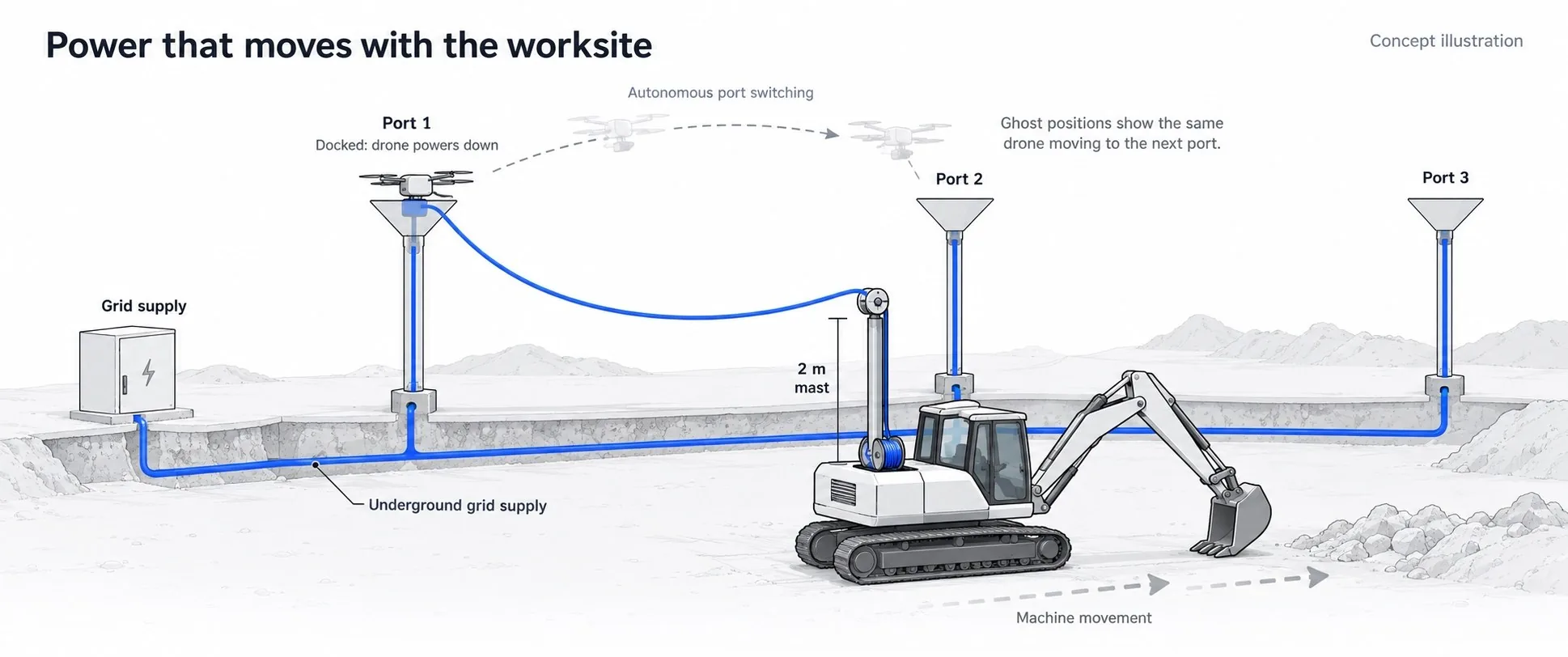
Custom Drone Docking Systems
We design, build, test and deploy custom drone docking ports tailored to your operating environment and project requirements.
| Energy Technology | Efficiency % | Emissions | Reliability |
|---|---|---|---|
| FPCA Grid Link | 95% | Zero Local | Max (Continuous) |
| Battery Electric | 80% | Zero Local | Variable (Charging) |
| Fossil Fuel (Diesel) | 35% | High Impact | High (Refueling) |
Infrastructure
Eliminate diesel fumes in urban centers and power high-torque heavy excavators 24/7 without refueling stops.
Extraction
Deep-pit operations benefit from reduced ventilation costs as electric machines generate zero heat and exhaust.
Cultivation
Power heavy tilling and harvesting equipment directly from renewable farm grids, slashing fuel dependency.
Frequently asked questions
Short, factual answers about the technology, who it is for, and how to work with us.
FPCA Technologies Private Limited is a deep-technology company in Kochi, India. We are developing an autonomous connector delivery system that lets heavy electric machinery run directly on grid electricity instead of batteries, and we provide custom engineering of drone docking systems for UAV operators.
An underground grid supply feeds elevated docking ports placed along the work area. A drone carries the electrical connector from a cable reel mounted on the machine to the nearest port, docks, and powers down. Grid electricity then flows through the tether to the machine. As the machine works across the site, the drone relocates the connector to the next port. The drone does not hover while power is supplied.
Agriculture is our primary market: compact farm machines such as tractors and tilling or harvesting equipment working bounded fields. Construction and mining are the next applications, including electric excavators and loaders on urban sites and in open pits.
Compared with diesel, an electric machine on grid power produces no exhaust at the point of work and avoids refuelling stops and fuel logistics. Compared with a battery, there is no large pack to carry, charge or replace, and the machine is not limited by pack capacity. Compared with a manually handled cable, the connector is delivered and switched between ports autonomously, so an operator does not have to drag, route or reconnect a live cable as the machine moves.
The autonomous connector delivery system is under prototype development and validation. Published performance figures on this site are design targets, not independently verified field results. Measured figures will be published as validation progresses.
Yes. We design, build, test and deploy custom drone docking ports for customer aircraft and sites. Depending on the agreed scope this can cover docking-station engineering, power or charging integration, alignment, sensing and telemetry, station controls, drone and autopilot integration, prototyping and testing. Deliverables are confirmed after a requirement review.
Email admin@fpcatechnologies.com or call +91 80864 30571. For drone docking projects you can also use the enquiry form on this page. Tell us your machine or drone type, the site, and your timeline, and we will reply with next steps.
We are incubated at Maker Village, Kerala Startup Mission's integrated startup complex at KINFRA Hi-Tech Park, Kalamassery, Kochi, Kerala 683503, India.
Be at the forefront of the kinetic blueprint for a fossil-free industrial future.