
Open-pit mining
The real cost of diesel in an open-pit mine, and what grid power could change
How much diesel big excavators and haul trucks burn, what it costs in India and abroad in 2026, and a step-by-step comparison with grid power that you can redo with your own numbers.
By FPCA Technologies · · 9 min read
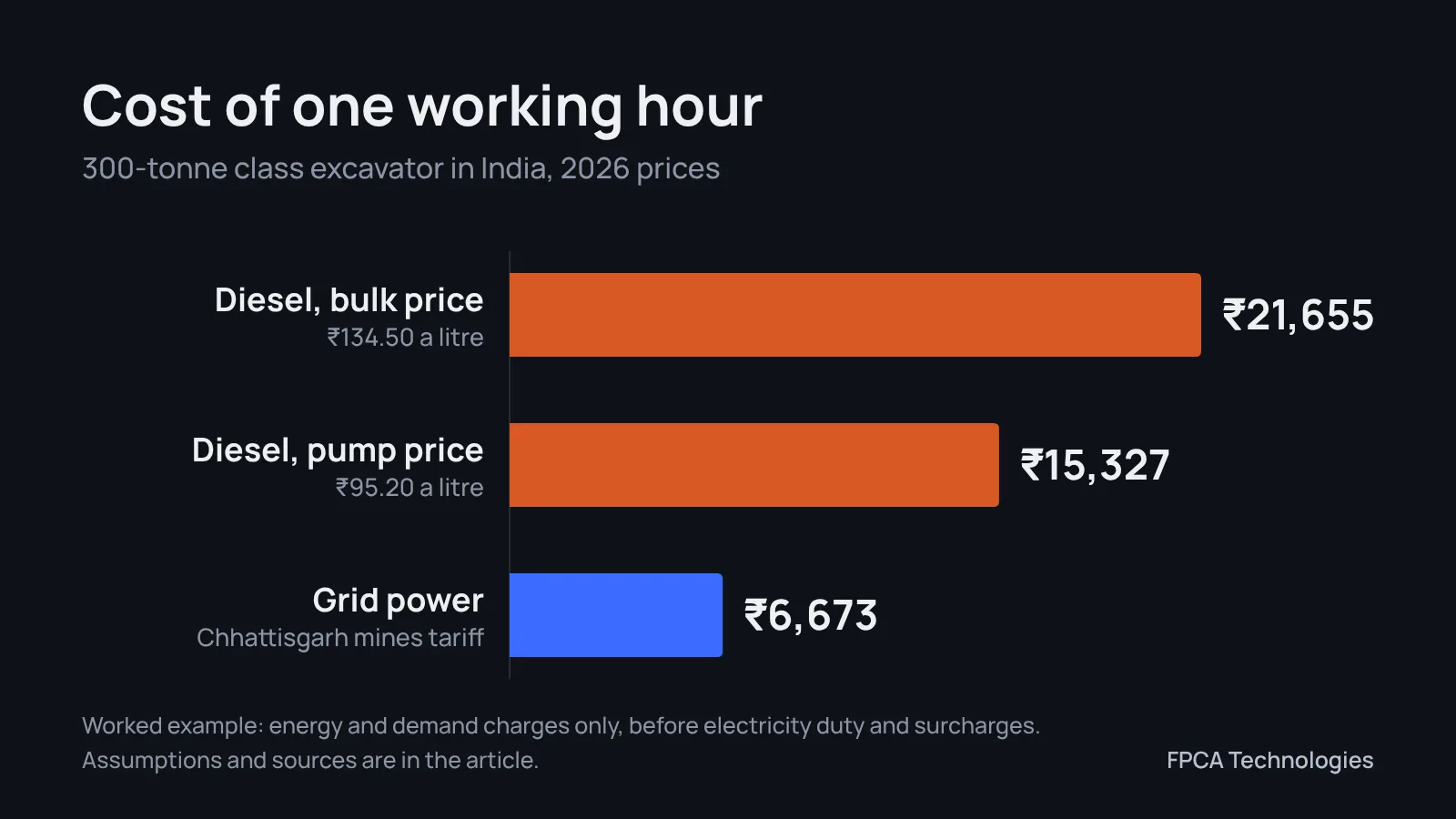
Fuel is one of the biggest running costs in an open-pit mine. Knowing what it costs per hour of digging helps you judge whether electric machines would pay off.
This article works it out step by step for one large excavator, with a source or a stated assumption for every figure, and compares it with doing the same work on grid electricity. Change the inputs to match your mine.
How much diesel do big machines burn?
Caterpillar publishes typical fuel use for its mining machines, based on telematics data from machines at work. The table converts its figures to litres per hour. Caterpillar’s low, medium and high figures assume the machine idles 50%, 30% and 10% of the time.[1]
| Machine | Class | Low | Medium | High |
|---|---|---|---|---|
| Cat 777G haul truck | about 90 t payload[3] | 45 | 59 | 73 |
| Cat 785 haul truck | about 145 t payload[4] | 67 | 88 | 110 |
| Cat 789 haul truck | about 190 t payload[5] | 101 | 135 | 169 |
| Cat 793F haul truck | about 230 t payload[6] | 121 | 159 | 196 |
| Cat 6030 hydraulic shovel | about 300 t operating weight[7] | – | 161 | – |
| Cat 6040 hydraulic shovel | about 410 t operating weight[8] | – | 203 | – |
For the larger shovels, Caterpillar gives one typical figure, shown in the Medium column.
Machines also burn fuel while they wait. A 2026 report by the US Lawrence Berkeley National Laboratory cites simulations in which haul trucks queuing at a shovel burned about 0.12 litres a minute, or about 7 litres an hour.[9]
What diesel costs in 2026
- India. Industrial and bulk buyers pay a different price from motorists, and the gap widened sharply this year. Coal India says industrial diesel at most of its subsidiaries rose from ₹92 a litre in mid-March to ₹142 on 1 April 2026.[10] In June, diesel cost ₹95.20 a litre at Delhi pumps while bulk sales were priced at ₹134.50, and on 11 June the government told industrial users to buy from bulk sale points rather than pumps.[2]
- Australia. On 30 October 2026, the wholesale (terminal gate) price of diesel in Perth was 258.8 cents a litre including GST.[11] Businesses can claim back fuel tax on off-road use: 53.7 cents a litre from August 2026.[12]
- South Africa. In October 2026, the wholesale price of 0.05% sulphur diesel was about R31.95 a litre in Gauteng.[13]
Electricity tariffs change too, but differently. In Chhattisgarh, for example, the state regulator sets the tariff for mines once a year, with a monthly fuel and power purchase adjustment on top.[14]
Where the energy goes
A litre of diesel holds about 10 to 11 kWh of energy.[15] Only part of it does useful work. A US Department of Energy study of mining cited 45% efficiency for diesel equipment but used 30%, because much of the equipment in use is older.[16] A simulation study of large diesel-electric haul trucks assumed the engine and generator turn fuel into electricity at about 40% efficiency.[17] The rest is lost, mostly as heat.
Electric drives waste much less. Under EU rules, most large low-voltage motors must be about 95–97% efficient at full load,[18] and variable-speed drives are typically 95–97% efficient at full load.[19] Allowing for cables and transformers on site, we estimate that roughly 85–90% of the electricity bought from the grid ends up as useful work.
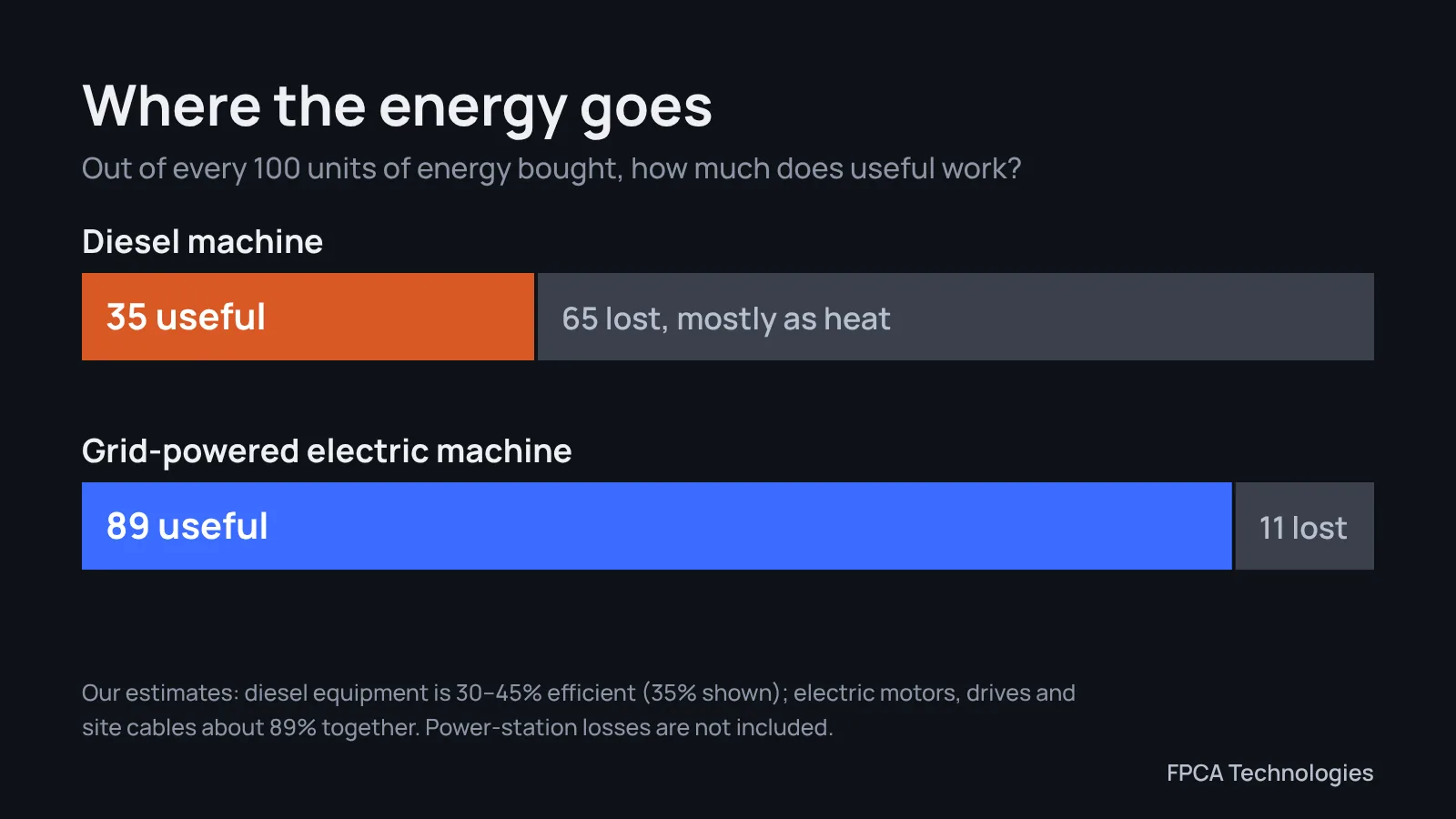
So to replace one litre of diesel, an electric machine needs roughly 3.4 to 4.5 kWh from the grid if the diesel engine is 30 to 40% efficient, and about 5 kWh at 45%. We use 3.9 kWh per litre below: about 10 kWh of energy × 35% engine efficiency ÷ 89% electric efficiency. A simulation study of large haul trucks at Sweden’s Aitik mine found a similar ratio: 229 kWh from an electric road replaced 60 litres of diesel, about 3.8 kWh per litre.[17]
Worked example: a 300-tonne excavator, diesel or grid power
Here is the comparison for a 300-tonne class hydraulic excavator in India. Every input is listed, so you can change any of them.
| Input | Value | Source or note |
|---|---|---|
| Diesel use | 161 litres an hour | Caterpillar 6030 typical figure[1] |
| Working hours | 6,000 a year (500 a month) | Our assumption: use yours |
| Diesel price | ₹95.20 (pump) or ₹134.50 (bulk) a litre | Delhi, June 2026[2] |
| Grid energy needed | 630 kWh an hour | 161 litres × 3.9 kWh |
| Power factor | 0.95 | Our assumption. The tariff bills kVAh, so 630 kWh ≈ 663 kVAh |
| Energy charge | ₹7.80 per kVAh | Chhattisgarh tariff for mines, 33 kV supply, from 1 July 2026[14] |
| Demand charge | ₹500 per kVA a month, on 1,500 kVA | Same tariff. The 1,500 kVA contract demand is our assumption |
| Diesel at ₹95.20 | Diesel at ₹134.50 | Grid power | |
|---|---|---|---|
| Energy | ₹15,327 | ₹21,655 | ₹5,173 |
| Demand charge | – | – | ₹1,500 |
| Total per hour | ₹15,327 | ₹21,655 | ₹6,673 |
| Total per year (6,000 hours) | ₹9.2 crore | ₹13.0 crore | ₹4.0 crore |
Two notes on fairness. The diesel prices are Delhi prices including taxes, while the grid cost excludes electricity duty and the monthly fuel and power purchase adjustment. And since 11 June 2026 industrial users have been told to buy at bulk prices, so the pump-price column is a best case for diesel.[2]
On these assumptions, grid power does an hour of digging for about ₹6,700, against ₹15,300 to ₹21,700 on diesel. That is a saving of about ₹8,700 to ₹15,000 an hour, or ₹5.2 to 9.0 crore a year. Put another way, grid power does the work of one litre of diesel for about ₹41.
Is the scale realistic? Fortescue says each of its electric excavators saves around one million litres of diesel a year.[20] Our example machine burns about 970,000 litres a year (161 litres × 6,000 hours).
What about CO2? The honest answer
Burning a litre of diesel releases about 2.7 kg of CO2.[15] Our example excavator therefore emits about 430 kg of CO2 an hour.
Grid electricity is not free of CO2 either. India’s grid averaged 0.727 tonnes of CO2 per megawatt-hour in 2023-24, according to the Central Electricity Authority.[21] At that rate, the 630 kWh the electric machine needs each hour come with about 460 kg of CO2.
So on India’s average grid today, moving an excavator from diesel to grid power saves money but not CO2: in our example it emits slightly more, about 460 kg against 430 kg an hour. In this example, CO2 savings start once the electricity emits less than about 0.69 tonnes of CO2 per MWh, for example with solar or wind supply, or in countries with low-carbon grids.
Some benefits do not depend on the grid at all: no diesel exhaust at the working face,[22] less noise and heat, and no engine to service.
Diesel costs that are easy to miss
- Price risk. As 2026 showed, the price a mine pays for diesel can rise by half in a few weeks.[10]
- Idling. Machines burn fuel while they wait, such as trucks queuing at the shovel.[9]
- Fuel logistics. Storage tanks, fuel trucks, refuelling time and fuel management all cost money.
- Health and the working environment. Diesel exhaust causes lung cancer, according to IARC.[22]
So is grid power always cheaper?
Not automatically. At 2026 diesel prices the energy saving is large, but it has to pay for electric machines, the power network and cable handling. A machine that works few hours a year, or a site far from the grid, may not make the case. A busy excavator in a long-life pit with good grid access is far more likely to.
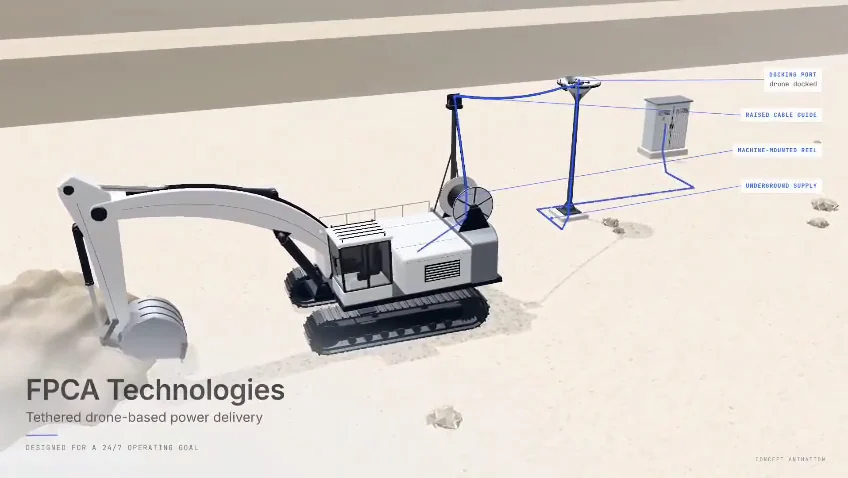
The hardest part is often not the price of electricity but getting it to a machine that moves. That is the cable problem, covered in Trailing cables in open-pit mines. For an overview of all the options, see four ways to power open-pit mining machines.
Where FPCA fits
Sources
- Caterpillar Performance Handbook: fuel consumption tables. Caterpillar (via Wheeler Cat), December 2022.
- Govt bars bulk purchases of petrol, diesel at pumps; here’s why. Business Today, 12 June 2026.
- 777 off-highway truck. Caterpillar, accessed November 2026.
- 785 mining truck. Caterpillar, accessed November 2026.
- 789 mining truck. Caterpillar, accessed November 2026.
- 793F mining truck. Caterpillar, accessed November 2026.
- 6030 hydraulic mining shovel. Caterpillar, accessed November 2026.
- 6040 hydraulic mining shovel. Caterpillar, accessed November 2026.
- Szum and Breunig, Diesel fuel consumption in prominent US open-pit mines: site-level estimates. Lawrence Berkeley National Laboratory, January 2026.
- CIL insulates Indian coal users from increasing input costs. Coal India Limited, 10 April 2026.
- Terminal gate prices. Australian Institute of Petroleum, price for 30 October 2026, accessed 2 November 2026.
- Fuel tax credit rates for business, 1 July 2026 to 30 June 2027. Australian Taxation Office, accessed November 2026.
- Fuel prices: current and past. Fuels Industry Association of South Africa, October 2026.
- Tariff schedule FY 2026-27. Chhattisgarh State Power Distribution Company (CSPDCL), from 1 July 2026.
- Emission Factors for Greenhouse Gas Inventories (GHG Emission Factors Hub 2025). US Environmental Protection Agency, January 2025.
- Mining Industry Energy Bandwidth Study. US Department of Energy, c. 2007.
- Lindgren et al., Drive-cycle simulations of battery-electric large haul trucks for open-pit mining with electric roads. Energies (MDPI), 2 July 2022.
- Commission Regulation (EU) 2019/1781 on ecodesign requirements for electric motors and variable speed drives (text via LawPlayer). European Union, 2019, as amended.
- Motor Systems Tip Sheet #11: Adjustable speed drive part-load efficiency. US Department of Energy, November 2012.
- Fortescue adds another electric excavator, says it is saving a million litres of diesel per unit. RenewEconomy, 8 April 2026.
- CO2 Baseline Database for the Indian Power Sector, User Guide version 20.0. Central Electricity Authority, Government of India, December 2024.
- IARC: Diesel engine exhaust carcinogenic. International Agency for Research on Cancer (WHO), 12 June 2012.
Figures were checked against these sources in November 2026. Prices and rules change, so use your own numbers. This article is general information, not engineering, legal or financial advice.
Read next
Open-pit mining
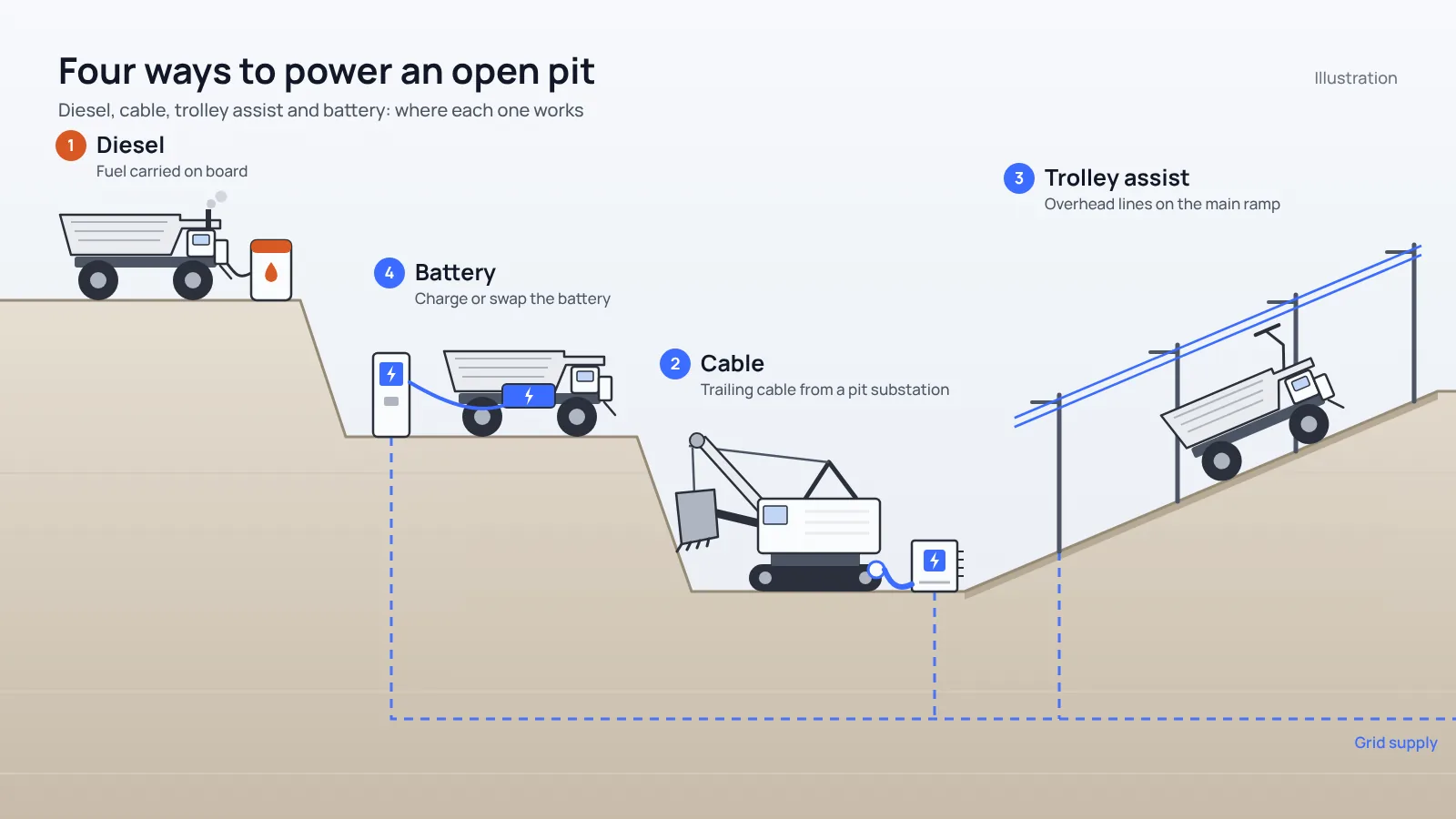
Diesel, battery, trolley or cable: four ways to power open-pit mining machines
A practical guide to the four ways of powering excavators, shovels, drills and haul trucks in open-pit mines, with real examples from India and around the world.
2 November 2026 · 10 min read
Open-pit mining
Trailing cables in open-pit mines: why they cost time and money, and how to manage them better
Why trailing cables on electric shovels, excavators and drills get damaged, what the safety rules require in India, the US and Western Australia, and 10 practices that cut damage and downtime.
2 November 2026 · 9 min read