
Open-pit mining
Trailing cables in open-pit mines: why they cost time and money, and how to manage them better
Why trailing cables on electric shovels, excavators and drills get damaged, what the safety rules require in India, the US and Western Australia, and 10 practices that cut damage and downtime.
By FPCA Technologies · · 9 min read
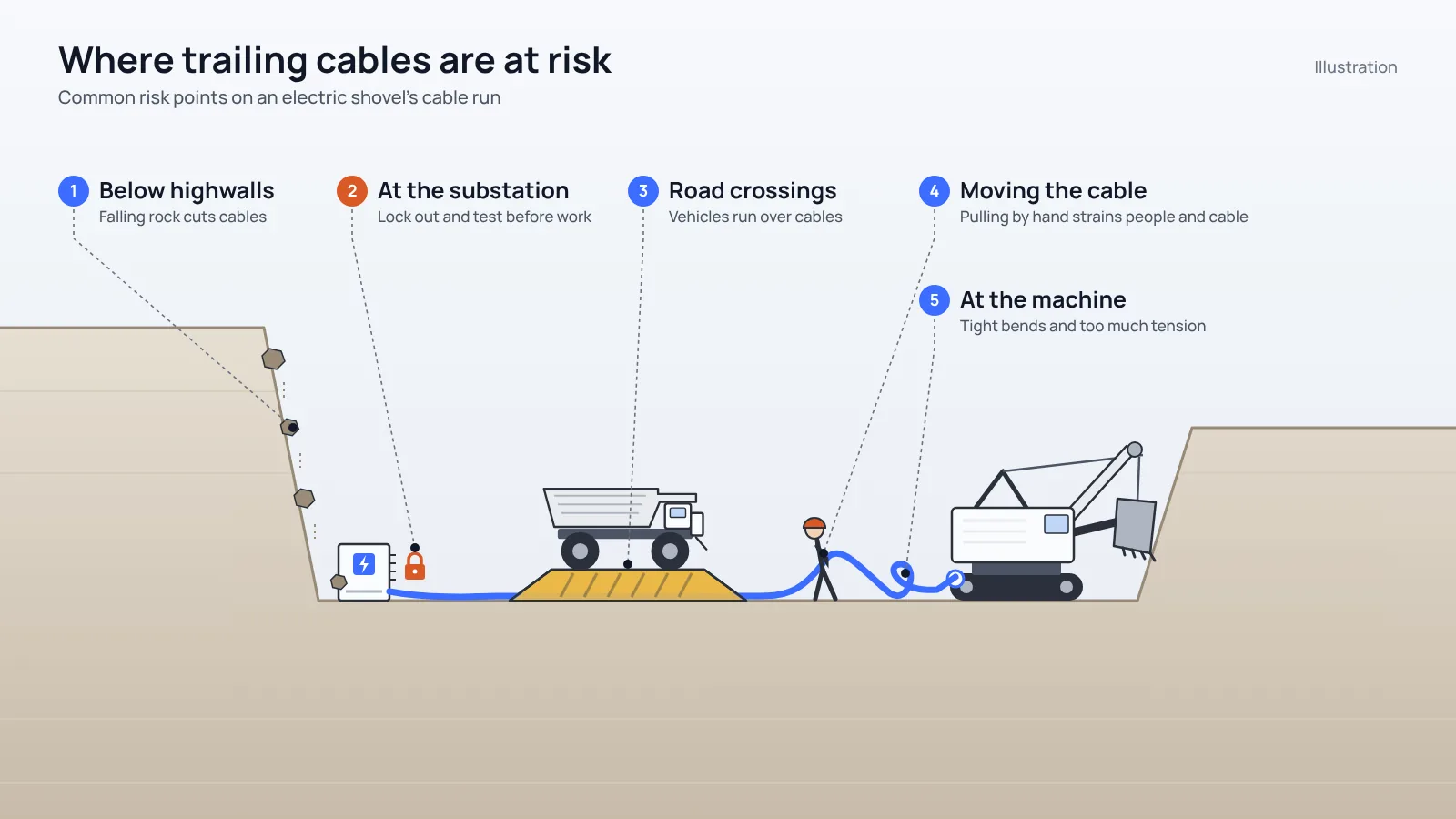
Electric shovels and excavators are the most proven way to run big open-pit machines on electricity. Their weak point is the cable that feeds them. A damaged trailing cable stops one of the most productive machines in the pit, and a damaged live cable can kill.
This guide explains how trailing cables are used, what goes wrong, what the rules require and which practices reduce damage and downtime, whatever equipment you run.
How a trailing cable feeds an open-pit machine
Power reaches the pit through a medium-voltage network and is fed from transportable substations, such as the 66/11 kV transportable substation at an open-cut coal mine in New South Wales described in a 2025 safety alert.[3] From there, a heavy, flexible trailing cable runs to the machine.
- Voltage. Large machines run at medium voltage. Komatsu’s 4100XPC rope shovel, for example, can be supplied at 6,000, 6,600, 7,200 or 11,000 volts on 50 Hz networks.[4]
- Cable types. In North America, Type SHD-GC cable is made for shovels, draglines and drills. It has shielded power conductors, two ground wires and a ground-check conductor that lets the protection detect a broken earth.[5] Australian surface mines use cables made to AS/NZS 2802, such as Type 409 for draglines, drills and face shovels.[6] In India, IS 14494 covers elastomer-insulated flexible cables for use in mines.[7]
- Weight. One metre of 11 kV Type 409 cable weighs about 15 kg,[1] so a few hundred metres weigh several tonnes. It cannot be moved safely by hand.
Why trailing cables cost time and money
Cable makers and safety studies point to the same few causes of damage:
- Falling rock and run-overs. Prysmian says falling rock and run-overs cause more than half of all surface mining cable failures.[2] A US Bureau of Mines survey of surface mines also found cables run over by mobile equipment and cut by rock among the most common causes.[8]
- Rough handling. The same survey found many cables damaged while being moved or transported.[8]
- Overloading on reels. Cable wound on a reel cannot shed heat as well, so its current rating must be reduced: in Prysmian’s guidance, to 85% with one layer on the reel and 35% with four.[2]
- Too much tension and poor splices. Cable maker AmerCable lists excessive tension and poor temporary splices among the main causes of failure.[9]
The bigger cost is usually downtime, not the cable. Prysmian says the cost of cable-related downtime often exceeds the cost of the cable itself, and that its recommended practices can cut downtime by up to 50%.[2] These are a manufacturer’s estimates. The best way to know your own numbers is to record every failure and its cause.
Moving the machine adds more. Relocating a shovel costs production time,[10] and its cable has to be moved, rerouted and protected each time.
The safety risks
Trailing cables carry enough energy to kill, and they lie where people and machines work.
- A study of electrical injuries in US mining from 2000 to 2009 counted 865 injuries, 39 of them fatal. Trailing cables were involved in about 9% of the injuries where the equipment was identified, mostly in underground coal mines, and 71% of those trailing-cable injuries happened while workers were handling the cable. Two deaths occurred when machines struck a trailing cable and their frames became energised.[11]
- In 2020, at a US surface sand mine, a bulldozer damaged a trailing cable. After the cable was spliced, the mine superintendent was electrocuted in a 4,160-volt electrical enclosure that had not been locked out.[12]
- In 2018, at a surface coal mine in West Virginia, a highwall miner operator who had been repairing the machine’s 7,200-volt trailing cable was electrocuted inside its on-board high-voltage transformer enclosure. A foreman at a substation about 1.5 miles away was switching the power on and off at his request by text message, and the switch was not locked or tagged out.[13]
- In India, electricity caused 29 of the 528 fatal accidents in coal mines from 2013 to 2022, according to the Directorate General of Mines Safety (DGMS).[14]
The lessons are consistent. Both deaths described above involved work on cable-fed equipment that had not been isolated, locked out and tested, and in the US study two people died when machines struck a cable and their frames became energised.
What the rules require
Rules differ by country but cover the same ground. This is a summary, not legal advice: check the current rules that apply to your mine.
- United States. Federal rules for surface mines (30 CFR Part 77, Subpart G) require short-circuit protection by automatic circuit breakers, marked disconnecting devices that show visibly when the power is off, well-made splices, protection of trailing cables from damage by mobile equipment, no making or breaking of connections under load, and rubber gloves when handling energised medium- and high-voltage trailing cables.[15]
- Western Australia. Trailing and reeling cables must meet AS/NZS 2802 and include a pilot core that cuts off the power if the earth circuit breaks. Earth-continuity protection must be tested routinely: the regulator’s guidance says every three months at surface operations, and every month at quarries, dredges and underground mines.[16] Cable repairs and testing follow AS/NZS 1747.[17]
- India. Electrical installations in mines come under the Central Electricity Authority (Measures relating to Safety and Electric Supply) Regulations, 2023, which have a chapter of additional requirements for mines.[18] Flexible mining cables are covered by IS 14494, which is under compulsory BIS certification.[7]
10 practices that cut cable damage and downtime
- Identify every cable. Give each cable, plug and outlet a unique ID, and keep its test and repair history.[1] Record every failure and its cause.[2]
- Plan the route before the move. Keep cables away from blasting areas and from rockfall below highwalls.[2]
- Never let traffic drive over a cable. Bury cables at road crossings or use arched cable bridges, and mark cable routes clearly.[2][16]
- Mechanise handling. Use machine-mounted reels, cable reel trucks or cable handlers instead of pulling cable by hand. One maker’s machine-mounted reel holds 300 metres of cable rated up to 15 kV.[19] The US survey found that strains, sprains, slips, falls and being struck by cable were by far the most common cable-handling accidents.[8]
- Pull gently. Move cable in several short loops rather than one long drag, limit tension and respect the minimum bending radius.[2][9]
- Derate cable on reels. Reduce the current rating for each layer of cable wound on a reel.[2]
- Monitor the earth. Use earth-continuity (ground-check) and earth-leakage protection, and test that it trips.[20][16]
- Inspect and test routinely. Have machine operators inspect cables visually in place as a routine, inspect and test cables, earths and protection after every relocation, and audit the system regularly.[1]
- Repair to the standard. Only competent people should repair and test cables (in Australia, to AS/NZS 1747), and splices must be mechanically strong, well insulated and sealed.[1][17][15] In the 2020 US accident above, none of the people involved were certified electricians.[12]
- Lock out, tag out and test before touching. Isolate at the source, lock and tag it, then prove dead every conductor you could touch, including the line side of switches inside enclosures, and earth high-voltage conductors before work begins, as your high-voltage procedures require. The accidents above show why.[12][13]
Where cable handling is heading
The trend is to take people out of cable handling, with machine-mounted reels, remote-controlled cable handlers and better monitoring. Some mines also power shovels from a mobile generator during long moves: in 2017, Teck’s Elk Valley coal mines in Canada did this for rope shovels moving between pits.[21]
For a wider view of how open-pit machines can be powered, see four ways to power open-pit mining machines. For the cost case, see the real cost of diesel in an open-pit mine.
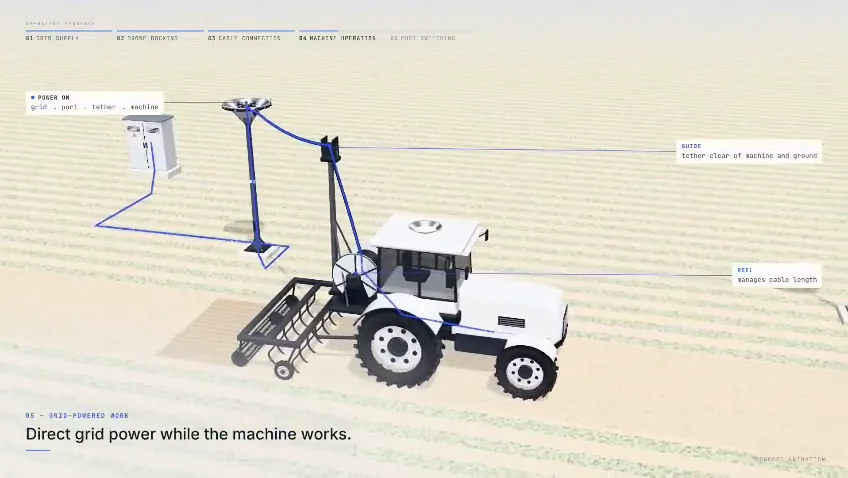
Where FPCA fits
Sources
- Mines Safety Bulletin No. 6: Handling and management of surface trailing cables. Queensland Department of Mines and Energy (now Resources Safety & Health Queensland), 19 April 2000.
- Surface Mining Cable Care & Maintenance. Prysmian North America, undated (published online April 2025).
- Safety Alert SA25-04: Electric shock from 11 kV ethylene propylene rubber insulated cable. NSW Resources Regulator, September 2025.
- 4100XPC AC electric rope shovel brochure. Komatsu Mining, 2018.
- Type SHD-GC mining cable specification sheet. Southwire, accessed November 2026.
- Type 409 trailing feeder cable to AS/NZS 2802. Tratos, accessed November 2026.
- IS 14494:2019 Elastomer insulated flexible cables for use in mines. Bureau of Indian Standards, accessed November 2026.
- Cable Handling in Surface Mines. Pincock, Allen & Holt for the US Bureau of Mines, 19 September 1980.
- A primer on cable damage and related failure of Tiger brand mining cables. AmerCable, 2025.
- Gong and Askari-Nasab, Short-term scheduling optimization for in-pit crushing and stockpiling operations considering shovel movement. Mining Optimization Laboratory, University of Alberta, c. 2025.
- Homce and Cawley, Electrical injuries in the US mining industry, 2000–2009. Transactions of the Society for Mining, Metallurgy & Exploration, 2013.
- Fatality report: July 9, 2020 (Hudson Sand Mine). US Mine Safety and Health Administration (MSHA), 2020.
- Fatal accident report, Bundy Auger Mining. West Virginia Office of Miners’ Health, Safety and Training, 2018.
- SANKET: Statistical Analysis & Numbers, Key Evaluation of Trends in coal mine accidents. Directorate General of Mines Safety (DGMS), February 2024.
- 30 CFR Part 77, Subpart G: Trailing cables. US Electronic Code of Federal Regulations, current.
- Electricity: trailing and reeling cables. WorkSafe Western Australia, updated 6 May 2025.
- AS/NZS 1747: Reeling, trailing and feeder cables used for mining: repair, testing and fitting of accessories. Australian Business Licence and Information Service, accessed November 2026.
- CEA (Measures relating to Safety and Electric Supply) Regulations, 2023: presentation. Central Electricity Authority, undated (c. November 2024).
- Trailing cable reel. Conductix-Wampfler, 2025.
- SE-134C / SE-135 ground-fault ground-check monitor datasheet. Littelfuse, accessed November 2026.
- Generator set powers rope shovel during pit-to-pit moves. mtu (Rolls-Royce Power Systems), 20 February 2017.
Figures were checked against these sources in November 2026. Prices and rules change, so use your own numbers. This article is general information, not engineering, legal or financial advice.
Read next
Open-pit mining
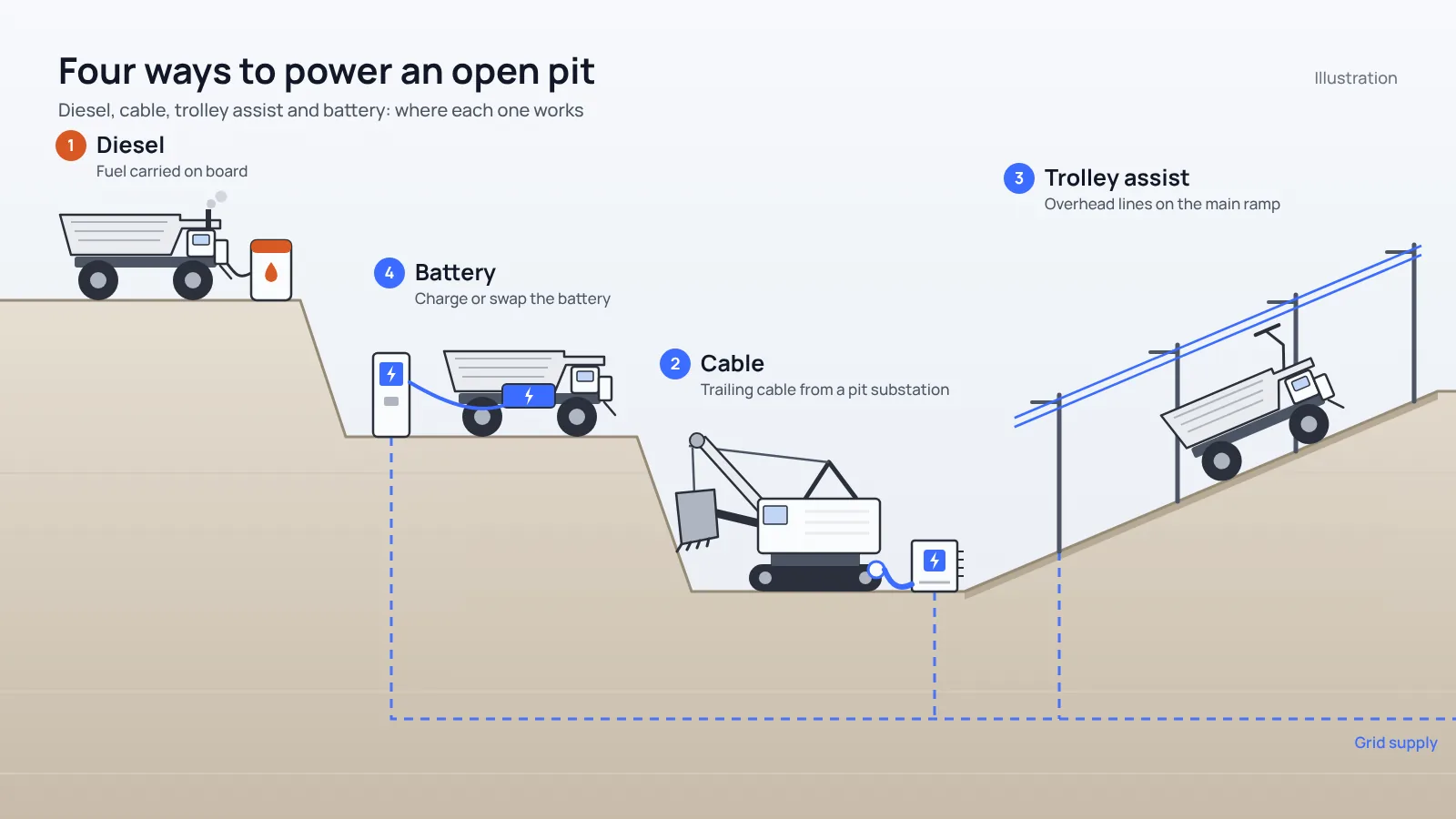
Diesel, battery, trolley or cable: four ways to power open-pit mining machines
A practical guide to the four ways of powering excavators, shovels, drills and haul trucks in open-pit mines, with real examples from India and around the world.
2 November 2026 · 10 min read
Open-pit mining
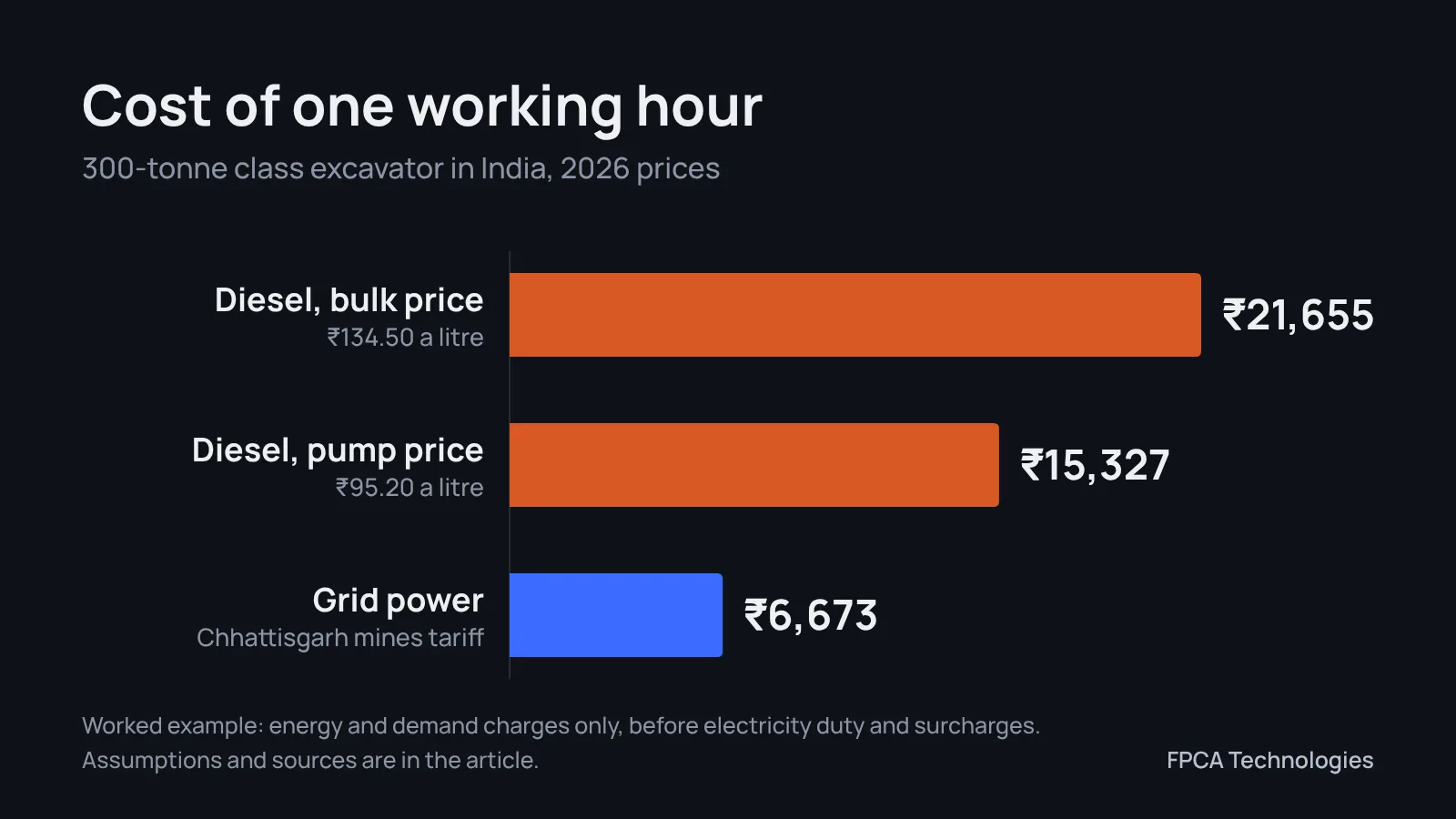
The real cost of diesel in an open-pit mine, and what grid power could change
How much diesel big excavators and haul trucks burn, what it costs in India and abroad in 2026, and a step-by-step comparison with grid power that you can redo with your own numbers.
2 November 2026 · 9 min read