
Open-pit mining
Diesel, battery, trolley or cable: four ways to power open-pit mining machines
A practical guide to the four ways of powering excavators, shovels, drills and haul trucks in open-pit mines, with real examples from India and around the world.
By FPCA Technologies · · 10 min read
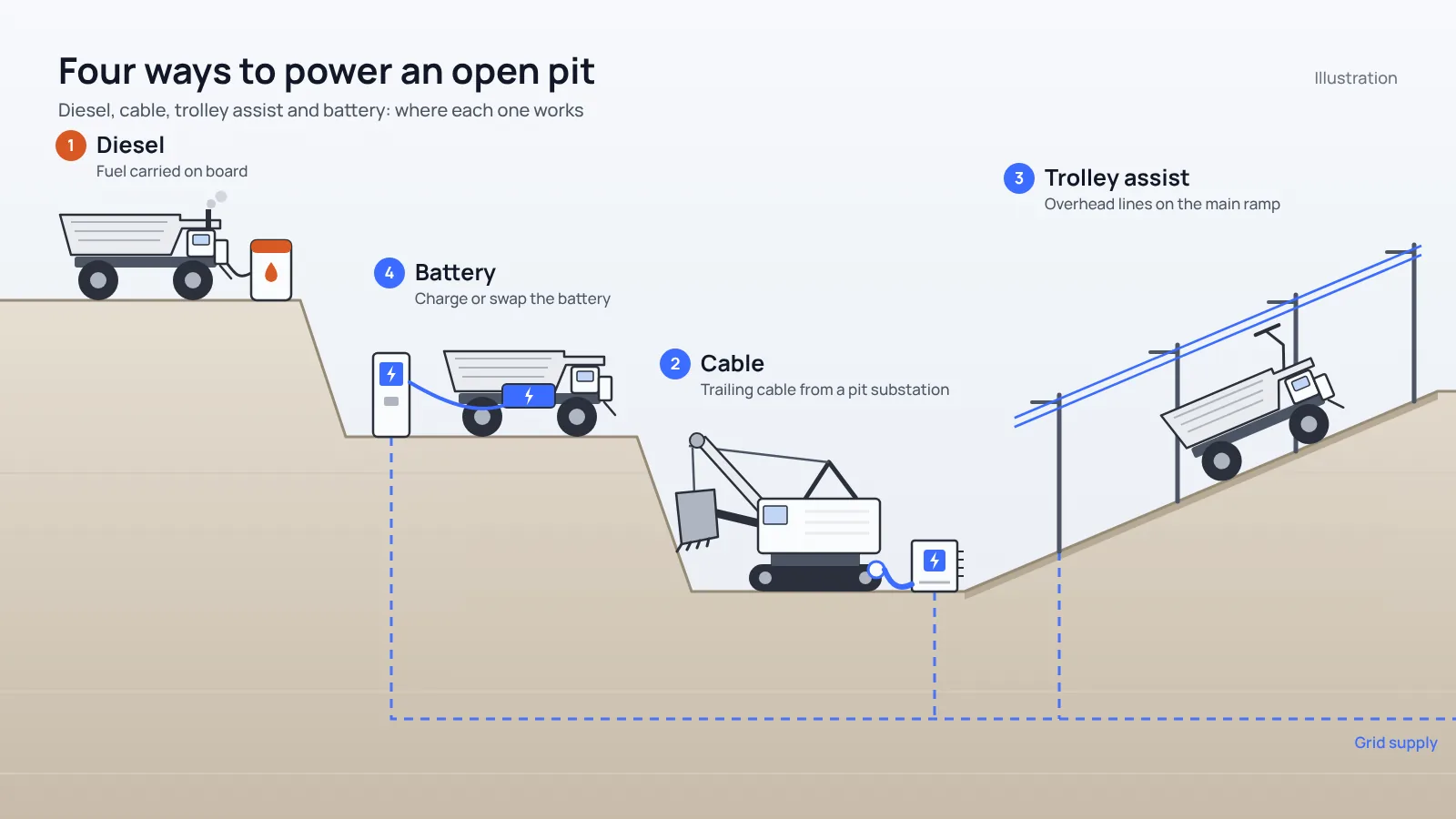
Walk around almost any open-pit mine and nearly everything that moves runs on diesel: haul trucks, most excavators, dozers, drills and water carts. That is starting to change. Volatile fuel prices, pressure to cut emissions and better electric machines are pushing miners to look at electricity.
But "going electric" is not one decision. There are four ways to power open-pit machines, and each suits some machines and mine layouts far better than others. This guide explains each one with real examples from India and abroad, so you can judge what could work at your mine.
Why this matters now
Diesel for mobile equipment is often a mine’s largest single energy use. A study for the Coalition for Eco-Efficient Comminution (CEEC) of copper, gold, iron ore, nickel and lithium mines found that diesel burned in mobile equipment made up about 45% of their final energy use; the rest was electricity.[1] Diesel is also the main source of direct emissions at many sites. The International Council on Mining and Metals (ICMM) says that typically 30–50% of a mine site’s direct (Scope 1) emissions come from diesel haul trucks.[2] At Rio Tinto’s Pilbara iron ore operations in Australia, diesel makes up about 70% of total carbon emissions.[3]
Cost and price risk matter as much as emissions. Coal India says the price of industrial diesel at most of its subsidiaries rose by about 54%, from ₹92 a litre in mid-March 2026 to ₹142 a litre on 1 April 2026, and that its diesel consumption in 2025-26 was around 4.19 lakh kilolitres (about 419 million litres).[4]
Open-pit mining is also where India mines almost all of its coal. In 2024-25, opencast mines produced 1,015.7 million tonnes of the country’s 1,047.5 million tonnes of coal, about 97%.[5]
1. Diesel: flexible and familiar, but costly to run
Diesel’s strength is freedom. A diesel machine can go anywhere on the site, refuels in minutes and needs no power lines or cables. Operators, mechanics and dealers everywhere know it.
Its weaknesses show up in the running costs:
- Fuel cost and price swings. Fuel is often the largest single cost of loading and hauling. A 2025 study of an open-pit copper mine in the Democratic Republic of the Congo found that fuel made up 63% of hauling costs and 59% of loading costs.[6]
- Wasted energy. A US Department of Energy study of mining put the efficiency of diesel equipment at 45% at best, and closer to 30% for the older machines in use. The rest of the fuel’s energy is lost, mostly as heat.[7]
- Exhaust. The World Health Organization’s cancer agency, IARC, classifies diesel engine exhaust as carcinogenic to humans, with sufficient evidence that it causes lung cancer.[8]
- Engines to maintain. Engines, fuel systems and exhaust treatment all need regular service and periodic overhauls.
For the numbers behind this, see our worked example in The real cost of diesel in an open-pit mine.
2. Cable power: the proven electric option for shovels, excavators and drills
Electric machines fed by a trailing cable are not new. Large electric rope shovels have dug in open pits for decades. Power comes from the grid to a substation in the pit, then through a heavy, flexible cable that the machine drags behind it as it works.
- Komatsu’s 4100XPC rope shovel can be supplied at 6,000, 6,600, 7,200 or 11,000 volts on 50 Hz networks.[9]
- Caterpillar’s 6060 electric hydraulic mining shovel has two 1,000 kW motors fed at 6.0, 6.6 or 7.2 kV.[10]
- Liebherr delivered BHP’s first electric excavator, an R 9400 E, to its Yandi iron ore mine in Western Australia in 2024.[11] Fortescue says each of its cable-powered electric excavators saves around one million litres of diesel a year.[12]
- Drills can run on cable too. Sandvik’s DR416iE electric blasthole drill is offered with a 420-metre cable reel.[13]
Indian coal mines use them as well. Coal India buys 20 cubic-metre electric rope shovels through central procurement,[14] and in April 2025 BEML delivered its 21 cubic-metre BRS-21 electric rope shovel to Northern Coalfields’ Nigahi mine.[15]
Even so, electric shovels are a small share of the world fleet. They made up about 1.5% of the surface mining machines counted by GlobalData at the end of 2023.[16]
The trade-offs. Cable machines need a medium-voltage network and substations in the pit. Their reach is limited by the cable, moves take planning, and the cable has to be protected from trucks, rock and rough handling. Managing that cable is one of the main day-to-day challenges of this option. We cover it in Trailing cables in open-pit mines.
3. Trolley assist: haul trucks on overhead lines
Haul trucks burn the most fuel climbing out of the pit fully loaded. Trolley assist strings overhead power lines along the main ramp. Diesel-electric trucks raise a pantograph, like a tram, and run on grid power while they climb. Off the line, the diesel engine takes over again.
- At Kansanshi in Zambia, a loaded truck climbs a 10% grade at about 23 km/h on trolley power, compared with about 11 km/h on diesel. In 2017 the mine said its trucks had burned some 8 million litres of diesel a year climbing out of the pit before trolley assist was installed.[17]
- The mine’s owner, First Quantum, now reports about 14 km of trolley lines and 128 trolley-enabled trucks in Zambia, and up to 90% less diesel on up-ramps.[18]
- At Copper Mountain in Canada, BC Hydro reported in 2022 that trucks on a new 1 km trolley line could climb at 20 km/h instead of 8 km/h, and that each would displace about 400 litres of diesel an hour while on the line.[19]
- At Boliden’s Aitik mine in Sweden, a 700-metre pilot line doubled truck speed on the ramp from 15 to 30 km/h and cut diesel use by 830 cubic metres a year.[20]
The trade-offs. Trolley lines are fixed infrastructure. They pay off on long ramps that stay in place for years, not on short-lived haul roads. Trucks need electric drives and pantographs, and the mine needs megawatts of grid capacity at the ramp.
4. Battery: from trials to the first fleets
Battery machines promise electric power without cables or overhead lines. For open-pit haul trucks, they are moving from trials to the first large orders, with China in the lead:
- GlobalData tracked 387 battery-electric surface mining trucks by March 2025, 72% of them in China.[21]
- At Huaneng’s Yimin open-pit coal mine in China, 100 autonomous battery trucks began operating in 2025. XCMG, which supplied them, says their batteries can be swapped automatically in under six minutes,[22] and each truck carries a 568 kWh battery.[21]
- Fortescue has agreed a deal worth up to US$2.8 billion with Liebherr for about 360 battery haul trucks, 55 electric excavators and 60 battery dozers by 2030.[23]
- In December 2025, two Caterpillar 793 XE battery trucks arrived at BHP’s Jimblebar mine in Australia for a joint trial with Rio Tinto.[24]
- Hitachi trialled a battery truck at Kansanshi that recharges while driving under the trolley lines. International Mining reports that Hitachi aims to commercialise it in its 2027 financial year.[25]
In India, BEML unveiled a 35-tonne battery-electric dump truck with a 300 kWh battery in April 2026.[26] As of November 2026, we had found no public report of a battery haul truck trial at a Coal India mine.
The trade-offs. Batteries are heavy and need a lot of charging power. A study of Sweden’s Aitik mine estimated that a 2,000 kWh truck battery would weigh about 13 tonnes.[27] In 2022, Hitachi said today’s battery trucks could run for only 1 to 3 hours between charges, against a full day on a diesel tank.[28] Charging big fleets also needs a big grid connection: McKinsey estimated that replacing the 27 diesel haul trucks at a sample open-pit iron ore mine, and the loading and auxiliary equipment that works with them, with electric versions would more than double the mine’s electricity demand.[29]
Which option fits which machine?
| Machine | Diesel | Cable | Trolley assist | Battery |
|---|---|---|---|---|
| Rope shovels and large excavators | Common (hydraulic excavators) | Proven for decades | Not used | Rare at this size |
| Blasthole drills | Common | Proven | Not used | Emerging: battery to move, cable to drill[30] |
| Haul trucks | The default | Not practical over long hauls | Proven on long, fixed ramps | First fleets, mainly in China; trials and large orders in Australia |
| Dozers | The default | Rare | Not used | In development; first orders placed[23] |
Questions to ask before you choose
- How long will this pit, bench or ramp stay in place? Trolley lines and fixed power networks need years to pay back.
- How much spare grid capacity does the mine have? Electric fleets need megawatts, and grid upgrades take time.
- What does useful energy cost you? Compare the cost of a litre of diesel with the cost of the grid power that does the same work. Our worked example shows how.
- Where does your electricity come from? The CO2 saving depends on how clean your power is.
- Who will manage the cables, and how? Cable damage and handling strongly affect whether electric shovels pay off. See our guide to trailing cables.
- What do equipment makers support in your region? Service and spare parts matter as much as the machine.
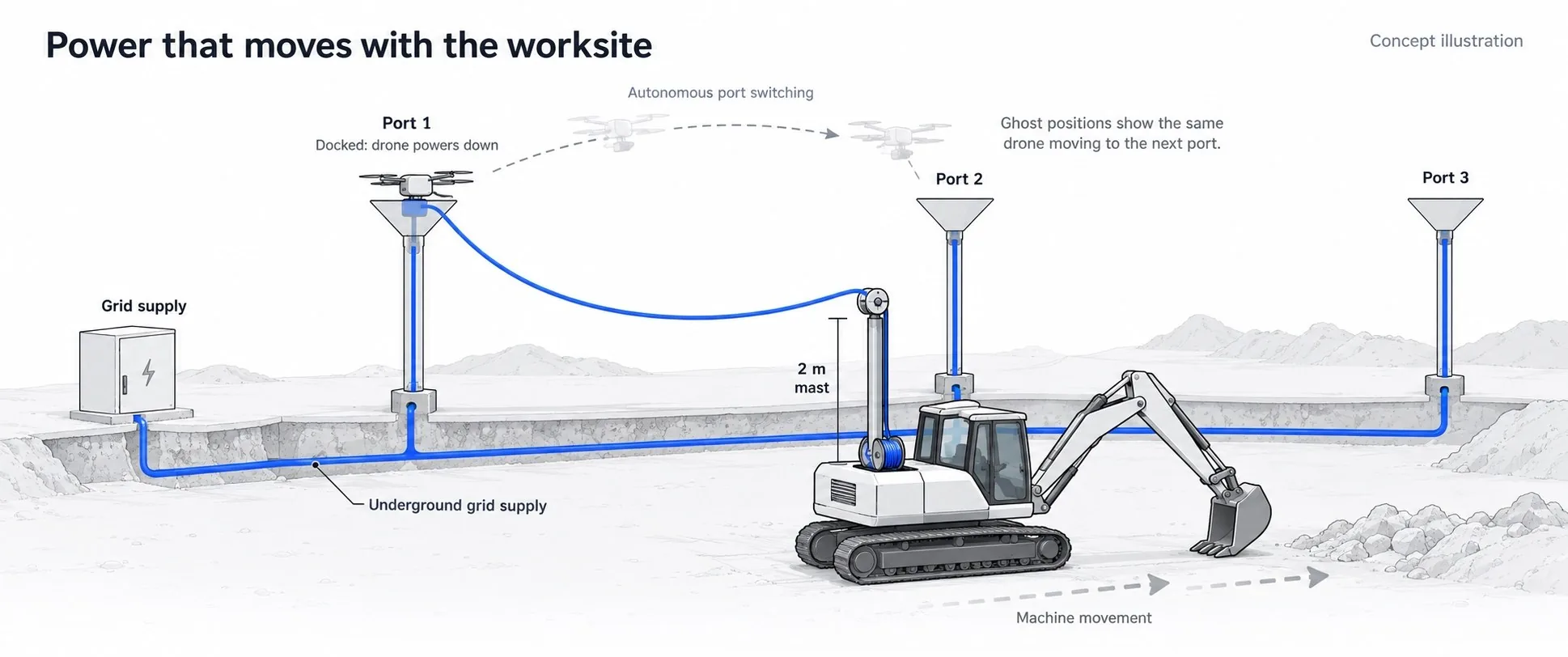
Where FPCA fits
Sources
- Mining Energy Consumption 2021. Coalition for Eco-Efficient Comminution (CEEC), report by engeco, 2021.
- The art of the possible: how collaboration is driving the transformation of large haul truck fleets. International Council on Mining and Metals (ICMM), 5 August 2024.
- Rio Tinto conducts first renewable diesel trial across Pilbara iron ore operations (exhibit to SEC filing). Rio Tinto, 26 February 2025.
- CIL insulates Indian coal users from increasing input costs. Coal India Limited, 10 April 2026.
- Production of raw coal from opencast and underground mines during the last ten years. Ministry of Coal, Government of India, accessed November 2026.
- Mboyo et al., Distribution of operating costs along the value chain of an open-pit copper mine. Applied Sciences (MDPI), 5 February 2025.
- Mining Industry Energy Bandwidth Study. US Department of Energy, c. 2007.
- IARC: Diesel engine exhaust carcinogenic. International Agency for Research on Cancer (WHO), 12 June 2012.
- 4100XPC electric rope shovel. Komatsu, accessed November 2026.
- 6060 hydraulic mining shovel (electric). Caterpillar, accessed November 2026.
- BHP’s first electric excavator. Liebherr, 22 August 2024.
- Fortescue adds another electric excavator, says it is saving a million litres of diesel per unit. RenewEconomy, 8 April 2026.
- Sandvik electrifies its largest intelligent rotary blasthole drill. Sandvik, June 2024.
- Engineering & Equipment Division. Coal India Limited, accessed November 2026.
- BEML unveils India’s largest indigenously developed rope shovel. BEML Limited, 29 April 2025.
- Mining equipment: carrying the load. Mining Technology (GlobalData), 21 August 2024.
- Big, clean, green machines. Mining for Zambia, 4 April 2017.
- 2025 Climate Change Report. First Quantum Minerals, May 2026.
- Copper Mountain’s powerful first step towards net-zero mining. BC Hydro, 15 February 2022.
- Climate transport. Boliden, accessed November 2026.
- Yimin coal mine: what 100 AI-driven electric trucks taught the mining sector. Mining Technology (GlobalData), 2 March 2026.
- World’s first 100 autonomous all-electric mining trucks begin operations at Huaneng Yimin mine. XCMG via PR Newswire, 28 May 2025.
- ASX release: Fortescue and Liebherr partnership. Fortescue, 25 September 2024.
- BHP and Rio Tinto welcome first Caterpillar battery-electric haul trucks to the Pilbara. BHP, 5 December 2025.
- First Quantum and Hitachi commission battery-electric mining truck at Kansanshi. International Mining, 16 April 2026.
- BEML unveils India’s first indigenous 35-ton electric dump truck. BEML Limited, 10 April 2026.
- Lindgren et al., Drive-cycle simulations of battery-electric large haul trucks for open-pit mining with electric roads. Energies (MDPI), 2 July 2022.
- Powering trucks for the long haul. Engineering & Mining Journal (E&MJ), hosted by ABB, May 2022.
- Electrifying mines could double their electricity demand. McKinsey & Company, 24 April 2023.
- First-ever battery-electric drill rig showcased. Creamer Media, 24 October 2024.
Figures were checked against these sources in November 2026. Prices and rules change, so use your own numbers. This article is general information, not engineering, legal or financial advice.
Read next
Open-pit mining
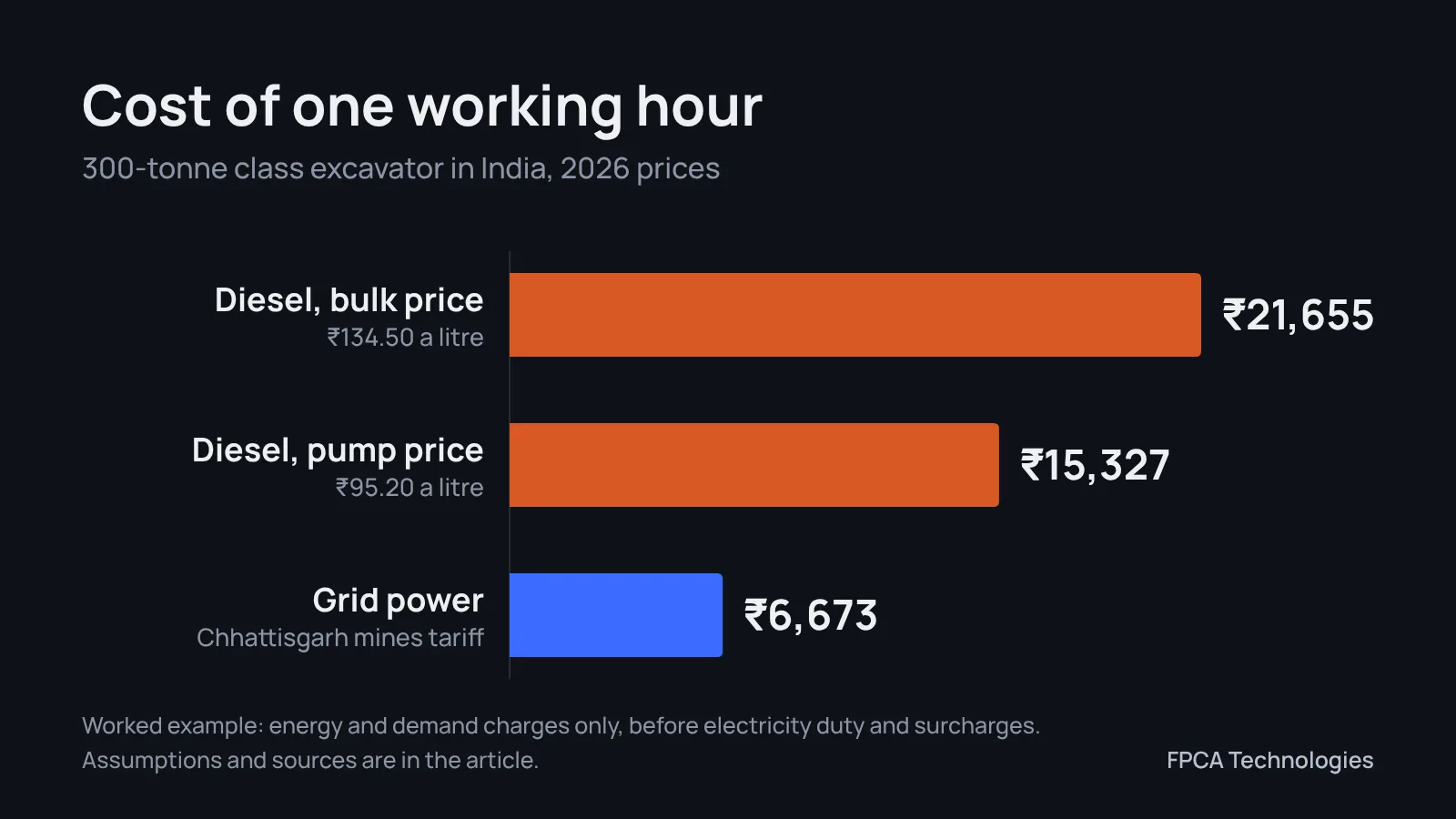
The real cost of diesel in an open-pit mine, and what grid power could change
How much diesel big excavators and haul trucks burn, what it costs in India and abroad in 2026, and a step-by-step comparison with grid power that you can redo with your own numbers.
2 November 2026 · 9 min read
Open-pit mining
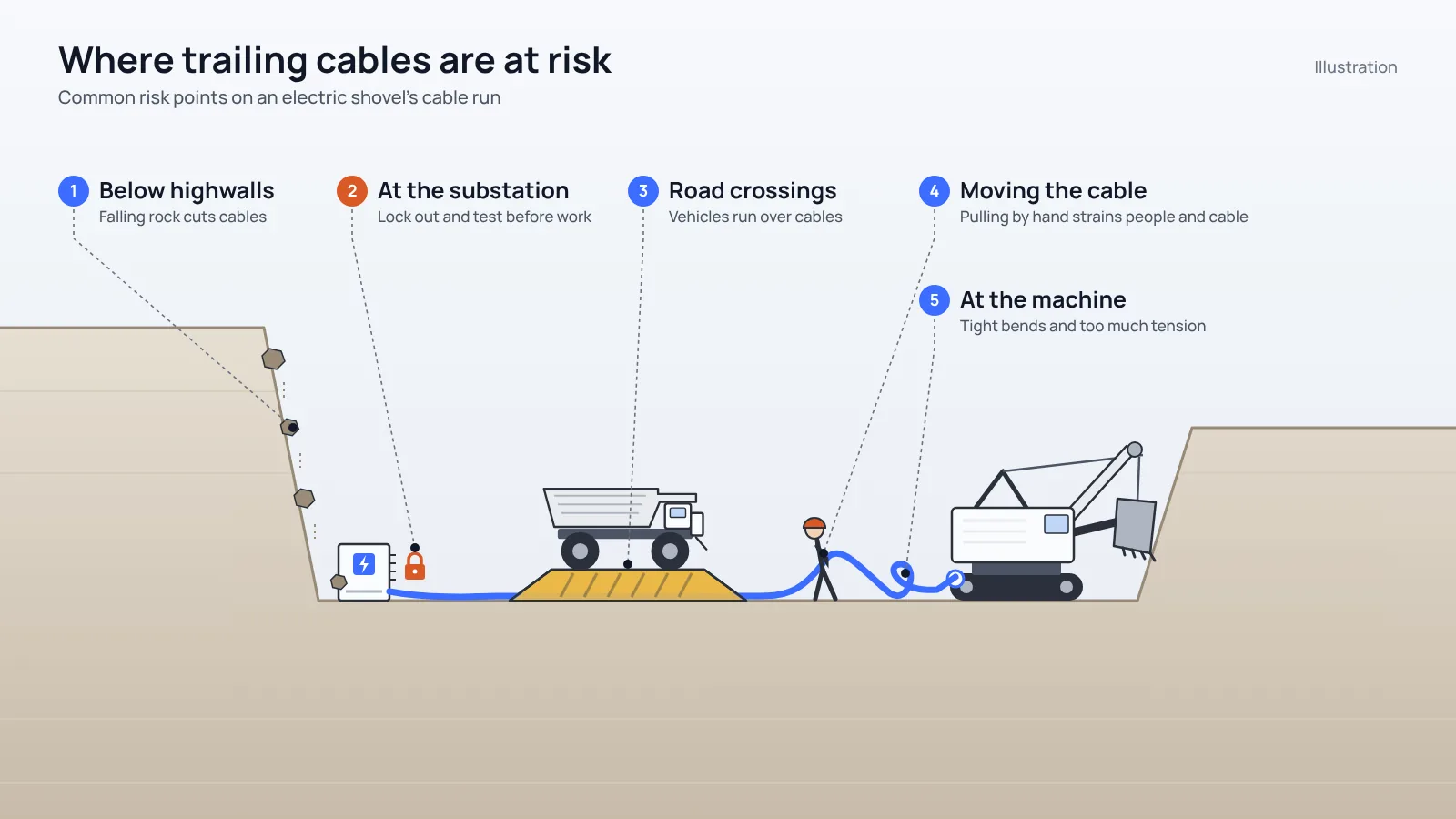
Trailing cables in open-pit mines: why they cost time and money, and how to manage them better
Why trailing cables on electric shovels, excavators and drills get damaged, what the safety rules require in India, the US and Western Australia, and 10 practices that cut damage and downtime.
2 November 2026 · 9 min read